Tuesday, September 11, 2012

GOING HOME

On Saturday, I stopped in Pullman, Washington to visit Washington State University, my alma mater. It's been  forty-five years since I graduated and well over thirty years since I last saw the campus.

I spent an hour trying to find my way around campus.  First of all the trees are a lot bigger -- to be expected after all these years. A lot of roads around campus were blocked off for game day. And the fields around the campus perimeter are now filled with apartment buildings.  I finally found my dorm.  It's looks pretty dilapidated and is fenced off for renovations.  The large parking lot, between my dorm and the field house is now filled with buildings. Regents Hills was one of the best, though not the newest, dorms when I was there in 1963-1967. Some of the dorms that were old back then still look good from the outside. I saw the home economics building, but it's called something else now.  Home Economics, as a field of study, no longer exists.The center of campus is blocked off so it's not possible to drive among the buildings.  I could see a couple of landmark buildings at a distance, but couldn't get to them easily.  The buildings were even more crammed together than when I was there, with almost no space between the buildings.  That's a good thing during winter when you have to walk from building to building in the blowing wind and the temperature hovers at twenty below zero.  The campus is still a mix of architectural styles, but it's the lack of green space that bothers me.

Nothing felt familiar. Nothing felt right. I had no sense of being at home or even being in a familiar place.  I drove past the church I used to attend; it still looked the same. I thought about going in but knew I didn't need to.

I am undone this afternoon.

I expected things to change, but I expected  some of it to still be familiar.  I had to hunt for anyuthing I even recognized.  College was a good time for me.  I liked being there and it was a good place for me to be. Many things happened on that campus that changed the direction of my life. Of course I didn't know ahead of time that I shouldn't have gone to campus. I am deeply sad when I leave campus. I know now I don't need to return. I learned my lesson really, really well today:  you can't go back.


My memories are better than what I saw today. It's a good thing to know where you don't have to go back to, or don't need to go back to for any reason.  My memories were disturbed today -- and I am not happy about that. I will begin to work through my feelings as I drive this afternoon.

In the meantime I am taking the very familiar drive through Colfax and on to Walla Walla. I suspect the drive  hasn't changed too much.  The wheat fields are still being farmed like they always have been.  As I look across the horizon I see wind turbines -- 30, 40, 50, or maybe more -- all new since I was last here.  There's plenty of wind out here so these turbines make sense. The wind turbines certainly change the landscape -- they are stuck up along the ridges like toothpicks or like children's pinwheels but the farming still continues around them.  They've been added to what was always here because it's the right thing to do for the environment. They are actually quite picturesque.

I am listening to Beethoven's Eroica Symphony on classic radio, a piece I know very well. As I watch the turbines that surround me, they are dancing to music.Their movement nearly matches the majesty of Beethoven's music.

This drive that I made so often in my college years, doesn't feel all that familiar.  I would have missed several turns without the highway signs.  And I had forgotten about crossing the Snake River out here among the wheat fields at Central Ferry.  How could a person forget something like that?

When I get to Walla Walla, Mary, one of Mother's long-time friends, welcomes me into her home.  We spend hours talking and sharing the conclusion of Mother's life.  I have felt an obligation, in the best sense of the word, to finish Mother's story with the friends who loved her.  On Sunday, we attend Pioneer Methodist Church, where I grew up and where my parents were active for over forty years.  It, too, has been renovated recently which is a great improvement to an old building.  One of Mother's hand-made banners was hanging over the sanctuary altar.  I'm told they often hang her banners she made years ago.I spoke with perhaps half dozen people who knew Mother, but that was all.  Six of us shared lunch afterwards, including Margaret, a beloved high school friend of mine whom I had lost touch with.  And there was dinner at Chuck and Lill's house that evening.  The conversations were wonderful and painful and personal and honest and fun as we sat table together.

On Sunday afternoon, Mary asked if there were any places or people I wanted to see while I was in town.  I had already decided I didn't need to drive by our old houses, or what remains of the schools I once attended.  I revisited those places when I was in town several years ago.  There was no reason this time.  I am keeping my memories.

I left early Monday morning, to spend time with my cousin Jim and his wife Donna in Portland, before going on to Cannon Beach.  My GPS wanted to send me through Milton Freewater, which was not our usual family route to Portland.  I drove through College Place to catch the road to Pasco.  The only problem was I never could find it.  I checked my map.  I never needed highway numbers in Walla Walla before.  After about thirty minutes, I found a traffic circle with a Highway 12 sign.  As I progressed around the circle, it neglected to give me a sign for the correct exit -- or at least I didn't see it.  In a few minutes I was back where I started.  I could see the highway I wanted.  I just couldn't get there.  I finally found more signs for Highway 12 but when I got close to actually getting on the highway, the roads were blocked off for construction with no detour signs.  I check my map again.  This time I realize the highway I want is the same one I used when I came to Walla Walla on Saturday. While there must be several entrances to the highway, the only one I knew was on the far end of town.  So, I head that way, through downtown Walla Walla, stopping at every traffic light, block after block.  Nearly an hour after I left Mary's house, I am finally on the road.

I was embarrassed and humiliated to admit I couldn't find the way out of my home town.  Or course it has changed too. The old landmarks are gone or look different, the highways have been added or rerouted, there are houses where fields used to be. 

The places I know best are the ones that undid me the most.  I got through Minneapolis, St. Paul, Fargo, Bismarck, Helena, and Missoula way easier than I got through my home town. But perhaps that's one of the lessons of this trip.  I've never had a desire to move back to Walla Walla or to return to my university for anything other than a visit.  The people from these places are important, but I've learned that it doesn't matter where we catch up with each other, because these relationships are not tied to place. So my trip is not about actually returning to the homes and schools and churches and towns of my younger life.  I know now it's about breathing in the landscape -- the fields, the rivers, the mountains, the lakes, the spaces where my life came to be.
 

DRIVING LOLO PASS

Heading over Lolo Pass to Walla Walla on Saturday

Lolo Pass is a wonderful mountain drive.  I know from previous experiences service stations and rest stops can be very far apart or non-existent in many rural areas in the West.  That was why I made sure my tires were good this morning before I started this drive. 

On my way across the pass I saw a sign for Lolo Peak -- it is over 9,000 feet high.  I don't see snow on top, though it's difficult to look for long since it is almost behind me. Amazing.

And there's a sign that says, "Moose Crossing."  Don't believe I've ever seen one of those before.  I've seen moose -- just not a sign saying they may be coming.

The thermometer in my car says it 44 degrees outside at 9:30 this morning.  It's cold here, but I am prepared with heavy shoes and socks and a jacket and a couple of blankets.  (Just reporting for those of you who were worried about me making this trip) 

At the top of Lolo Pass I cross into Idaho.  It's 6% grade going down this other side.  The mountains are so high here that I can't even see the sky out the side windows and often not out the windshield.

The sign I just passed says, "Winding road for the next 99 miles." I love crooked winding mountain roads so this day is just getting better and better.

I just found two deer standing beside the road.  I am able to drive within 5 feet of them and they just watch me, unafraid.  They only problem is they are standing in a gravel parking area beside the road -- they should be in the woods or at least in the grass so my picture shows them in their native habitat. They had no intention of moving. 


Russian Creek is running beside the road.  It's rather shallow and wide, but filled with rocks and timber and logs.  It's the kind we used to camp beside when we were growing up, the kind that as kids, we always tried to dam up with rocks.

As I descend the Idaho side of the pass I look ahead and see what appears to be fog.  As I get closer I realize it is smoke from forest fires someplace in the area.  I don't know if it's a wild fire or a controlled burn.  I don't see any flames, but I know smoke can travel a long ways. The smoke is so thick in some places it really limits visibility.  It's like driving in a thick grey fog. A few miles up the road I stop at the ranger station for a break and to inquire about the fire.  I talk with a gentleman in the parking lot who is studying a topographic map.  He says the smoke is from wild fires across the river, that there are multiple fire locations, but they are not near the highway.  The air is very smoky and I can certainly smell the forest burning. 

Just as I get to Kooskia, all the mountains that were completely covered with evergreens on Lolo Pass are now totally bald.  They totally fill my windshield.  There are a few trees dotted here and there but the entire landscape changed rather suddenly.

After Kamiah, the road is hugging the edge of the bald hills with the river just below the edge of the road. There's still a lot of smoke which makes it difficult to see how high and large these hills.  It's like  putting everything in a fog.  I'm not even trying to take pictures.  In clear weather it's a challenge; in the smoke, nothing will show up.  I'm obviously going to follow smoke for a long time today.


Dworshak Dam
At Orofino, I stop at the Dworshak Fish Hatchery and Dam. I've heard about these places for many years and even seen photos, but have never been here in person until today.  This stop is for Dad, who did much of the design work on this state-of-the-art hatchery when it was built many years ago.  An important part of the dam building projects was to make sure the fish were taken care of, that they had a way to return to their spawning grounds.  I only wish Dad was here to explain all about the hatchery to me -- it would make a lot more sense.  There were no personnel here today because it's Saturday, so I relied on the signs for explanations.
The spillway
The fish hatchery
After I leave Orofino I continue to drive along these huge bald hills.  I marvel at their size.  I've seen similar balds before but it's been a long time.  Their color is like tan suede.  There is an occasional house on these balds, but these are not farms because the hills are too steep.  There are a few trees along the bottom. I see Walla Walla, my home town, on the road sign for the first time:  127 miles.  My route will be longer since I am going through Lewiston, Idaho and Pullman, Washington on the way.

When I get to Lewiston, my plan is to go up the Lewiston Grade -- a famous road for it's twists and turns and steepness.  When I was in college we often drove the grade on weekend afternoons just to get off campus for awhile. The road now is four-lane which makes the drive easy, but does not reduce it's spectacular climb to the top of the balds and bluffs. The fields are harvested, all that remains is the yellow straw and stubble. At the top of the grade, I enter the State of Washington and am heading towards Pullman, the home of my alma mater, Washington State University. I have finally gotten above the smoke after driving in it for several hours. The wheat fields are absolutely gorgeous.  I am grateful these rolling hills are not obscured by the smoke.

I'm on a two-lane winding road through the wheat fields and just passed about ten small combines coming the other way.  The cars in my lane moved over to make room for them since they take up more than their lane. I had forgotten that large farm machinery is often on the main highways out here.

I can't get enough of the scenery here.  It feels like home and I am soaking it up like a sponge that has been dry for many years.  As I drive I sometimes wonder if my friends would find this as beautiful and stunning as I do.  On this entire trip, through Iowa and Minnesota and North Dakota and Montana it is the landscapes that fill a deep place within me, it's the landscapes that feed my soul.  I'm thinking now this trip might not be long enough....to restore what has been missing for a long time. Perhaps it's been a longing that only now I am beginning to understand.

Monday, September 10, 2012

FOR THOSE WHO WERE WORRIED


Friday night in the boonies, somewhere north of Missoula

About 10:00 p.m., with thirty miles yet to go on my loop drive before I get back to Missoula, an orange icon lights up on my dashboard.  I don’t even know what the light means.  It’s pitch black out here and very difficult to find a safe place to pull off on this two-lane road.  I drive on for about ten miles, hoping to find a place, like a gas station or minute market.

When I finally spot one, I pull in and get out my car manual to find out what the orange light means:  under-inflated tire. Of course it doesn’t tell me which tire. (Adam: here's an improvement option for Honda) I walk around the car, trying to determine which tire is the problem, and then walk inside to inquire if they have any air.

They don't have air.  A young man nearby overhears the conversation.  "I have something in my truck that will help you," he says.  "I'm parked at the bar next door, so I will be back in a minute."  With that he is gone.  In the meantime, I got back outside to my car.  A young woman comes by and says there is air at a gas station down the nearby side road.

When the young man returns, he has a tire gauge.  He checks the right rear tire and determines it is three or four pounds low.  I leave for the nearby gas station for air.

When I get to the gas station, I drive around the lot looking for the air hose, which I never find.  In the attached market, I see a man inside who is obviously closing the market for the night.  He is watching me as I drive around the station.  I stop at the door and get out.  He opens the door and inquires if he can help me.  I tell him my story.  He directs me to the nearby hose and says he will take care of my problem.

I leave the car running so we can tell when the dash light goes off. He walks around the car and determines the low tire in the left rear.  As soon as he puts some air in the light goes off, so we know that was the offending tire.  

I thank him and shake his hand.  "Always glad to help," he says.

I drive the last thirty miles with no incident and finally arrive at the B&B about 11:00.  That's the night I told you there was no blog and that I needed sleep.

The next morning, Saturday, I am up early with a plan to be out of Missoula by 7:00.  Breakfast at the B&B isn't until 8:30, so I stop by McDonald's for a biscuit -- a poor excuse for a biscuit, I might add.  As I pull out of McDonald's the orange light comes on again.  Putting air in the tire last night was evidently a temporary fix.

I locate the nearest Honda dealer on my nifty GPS system, thinking I will take it there since my car is new.  They don't open until 9:00 and they don't do service on Saturday.  I make a couple of calls to nearby service stations but they don't do tires.  I am on a street with lots of businesses so I start driving, looking for someplace that might fix my tire. Within a few miles I find a tire store that is open.  By now it is 7:30.  I go in, explain my problem, and the man says they really don't open until 8:00. "No problem," I say.  "I'll wait."

At 8:00 I explain my situation to the tire guy.  "I have a problem with the left rear tire and the light is coming on," I say, and explain what we did the night before.  "I'm going over Lolo Pass this morning and I want you to check all of my tires to make sure I am good to go." 

 "No problem," the guy says.

"And you're going to be an example of how nice the people are in Montana, aren't you?" I say, half kidding with him.

"Of course," he says.

They have me ready to go in less than an hour.  Turns out I had a small piece of metal in my tire. They removed the metal and plugged the tire.

"You're ready to go," the tire guy says.  "All your tires are good."

"What do I owe you?" I ask.

"Nothing," he says.

I thank him, shake his hand, and I am on my way by 9:00.

CROSSING THE MOUNTAINS ON FRIDAY


Heading towards Helena, Montana, I am surrounded by mountains on three sides.  My crayons are not sufficient for the panorama.  This scene requires watercolors and broad brush strokes to catch the purples and greys and tans of the mountain. The wide sweeps of harvested wheat fields are a yellowish tan, polka dotted with dark clumps of trees along the landscape. 

At McDonald pass, between Helena and Missoula, I am climbing steep into the mountains.  Sometimes when I round an uphill curve all I see is sky for a second or two, the rest of the mountains are down below.  The ranges are piled one upon another as far as I can see.  Up close they are a charcoal green because of the mixture of many dead trees amongst the living.  This is the first real mountain driving I have done on this trip.  Wherever I was when I called Montana heaven – well that was just the suburbs of heaven.  This is the real thing.

I’ve been listening to Sirius radio, mostly classical music as I drive.  As I start down the other side of McDonald pass, I hear George Gershwin’s “An American in Paris.”  What an odd sensation – urban music with honking horns while I am in the middle of specatular mountains. I cannot connect these mountains and that music in any way in my mind.

The hay between Helena and Missoula is stacked in huge piles, perhaps ten or twelve feet high, rather than rows of round bales.  A split rail fence surrounds the base, set perhaps five feet away from the hay stack, to prevent livestock from eating directly from the pile. Before now, everything has been either round or rectangular bales.  I am reminded of pictures I’ve seen of agricultural areas in Europe. 

I arrive in Missoula about 3:00, check myself into the B&B, then set out on a 300-mile loop drive north to Whitefish and back.  I know it’s too much for the rest of the day, but it’s my only chance to see this area and my scenic road book says it’s a good drive. 
 
Before I leave Missoula for the loop drive, I stop for gas.  Right next door was Starbucks, so I’m thinking today is really my lucky day.  I haven’t had a single mocha since I left home and I’ve been looking for one. I've just never been in the right place at the right time. While I am pumping gas, a girl comes out of the gas station market with a bag of popcorn.  I have discovered I love munching on popcorn during afternoon drives.  Now I have a dilemma:  popcorn or mocha.   What to do? I can’t do both.  I opt for the popcorn – it lasts longer. I will save Starbuck’s for another day.

As I drive through the Flathead Indian Reservation, one of the first things I notice is that the highway signs are written in two different languages:  Native American first, English second.  I don't recognize some of the script. It’s a great reminder of where I’m traveling and on whose land I am on.  It makes me feel like a visitor when I can’t read the signs, or only part of the signs. For me, it creates an interesting environment.
The Mission Range on the Flathead Reservation
St. Ignatius Church
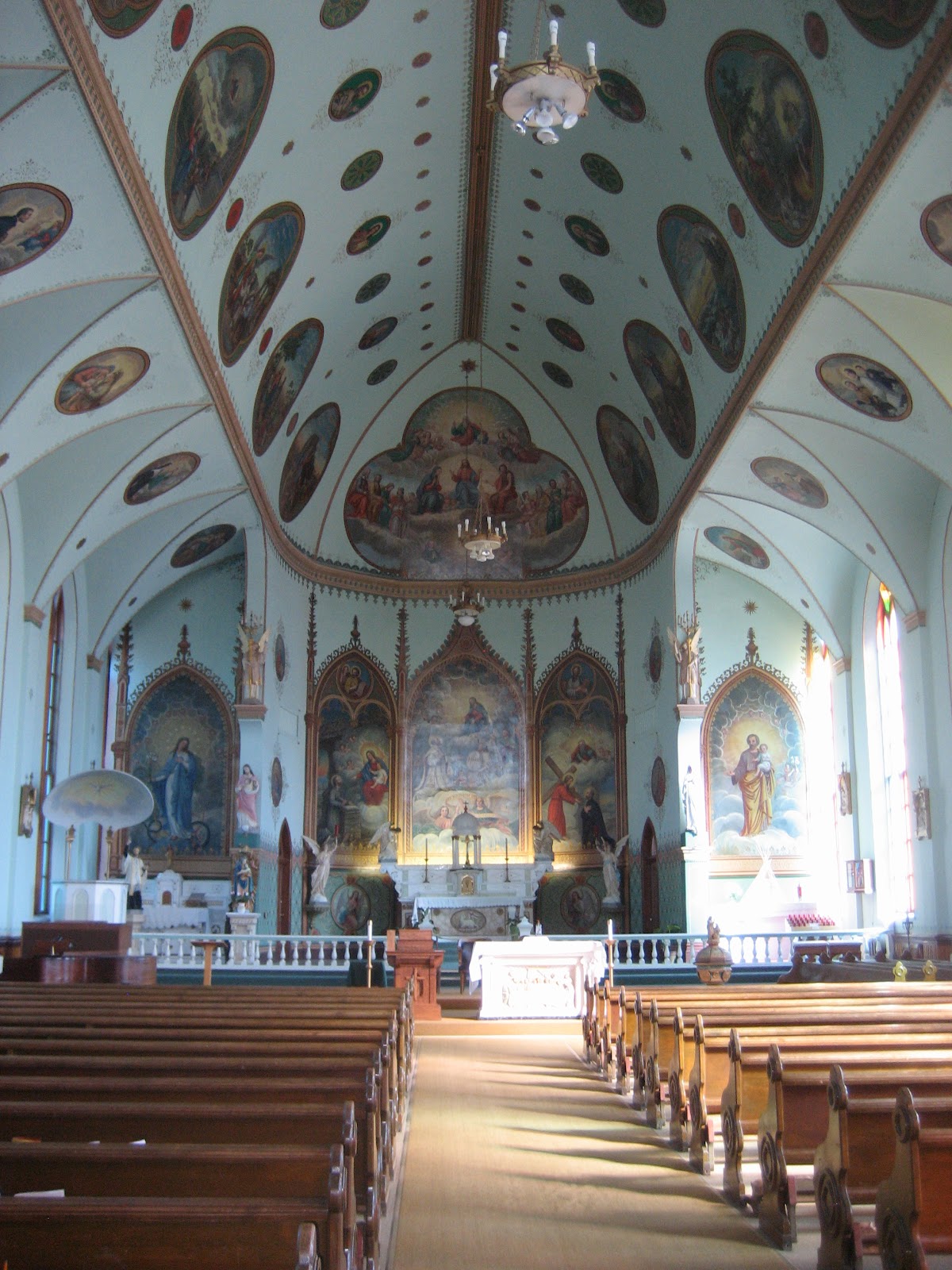
Interior of St. Ignatius Church

I’m following the Mission Range, black base with grey peaks, rising out of the flat valley.  St. Ignatius Church, a rather ordinary looking brick church, sits in this valley.  Inside it’s very ornately decorated, not gold and marble like the Cathedral of St. Paul, but very appropriate for this place.  One of the side altars has a teepee on it, I assume to honor the Native American people who live and were converted here.

As I head toward Polson, I come around a curve and am surprised by Flathead Lake which completely fills my view.   The lake is bright blue, the sky is clear and cloudless, and several ranges of mountains encircle the lake.  Farther along the shore the Town at Polson Bay looks like a wonderful place to come and stay for a while.  Part of the harbor is filled with sailboats – a scene I didn’t expect in the midst of the mountains. There are also small islands dotting the lake, some have houses on them.  Really cool.
Mission Range

Flathead Lake

At Lakeside I saw a sign for charter fishing boats.  Wouldn’t that be a great thing to do on my next trip.  I don’t even know how to fish but I would certainly be willing to go along for the ride and let other people fish.

 I am just totally blown away by the beauty here at the end of a day that has already been wonderful.  It started with Louise, then I found Louise’s home place and the area where Dad grew up, I drove through the mountains and over McDonald Pass, and was debating about whether I could do another 300 miles today on this scenic loop.  It has been worth every mile, to soak up the natural gorgeousness.   Even if it gets dark before I get all the way back to Missoula it’s been worth the extra time.  I’ll pick up fast food for dinner (my first burger in fries since I left home) so I can take in as much of this scenery before darkness falls.
   
The sun is starting to set at 8:20 and I’m starting the southward part of the loop.  I like seeing the mountains in silhouette which makes them even more spectacular than they were earlier.  This is the first night of the entire trip I have driven in the dark to get to my bed for the night.  But it’s o.k.  It’s been a great day.


Family?


I have been without internet access for several days.  I have been writing but was unable to post.  I should be caught up in the next couple of days.

* * * * * * * 

Townsend, Montana

I spent Friday morning with Louise, Dad’s childhood neighbor.  I met her for the first time the night before, along with two of her nieces.  But Friday was just the two of us at her house, sharing coffee and homemade cookies and conversation.

If I didn’t know better, I would say Louise is family:  she talks like family, she’s warm like family, she knows family stories.  But we’ve just met – and the only thing she knows about my family is from sometime after her birth in 1917 until about 1930.  She is five years younger than Dad, but she remembers him very well.  She also remembers his sister Frances and his brother Jim and his father Will. She says Dad’s mother was always very nice to her.  “She was a fine woman,” she told me.  Louise’s family and Dad’s family were close neighbors; they only lived a mile apart near the tiny town of Toston, Montana.

I wanted to know the connection, a connection that lasted their entire lives, between Louise’s brother Frank and my dad.  Frank was a year and half older than Dad; he was born on March 1, 1911.  Dad was born on November 26, 1912.  According to Louise, Frank was a man of few words.  Louise says he never talked about personal things, though he liked people a lot.  Dad was the same way – always involved with people and projects but seldom divulging interior thoughts or feelings.  I am wondering, even as young boys, if they understood that about each other.  I am also wondering what effect Dad’s broken arm and resulting lifelong handicap (though we never used that word) had on Frank.  I think those things can have a tremendous effect on young children.  Of course we will never know the answers; we can only speculate.

We talked about farm life in Montana and how you learned to make do and cope with whatever happens.  Life was hard and I suspect Dad’s parents cut him little slack. Louise and I talked about how you do the best you can and you go on.  We talked about how our families moved across the prairies in the late 1800s and early 1900s and how hard that must have been.  If people died along the way, you buried them where you were and kept on going.  But people were determined to move west.  Louise said people came to Toston in the 1860s because of the gold in Confederate Gulch where her family still has a cabin.  It was the richest gold location for miles.  Back in 1965, Frank took Dad and me to the cabin for an overnight.  We fished for trout, cleaned them, and Frank fried them for breakfast the next morning.  I remember him showing us the tobacco cans, nailed to the trees that held claim papers for gold in certain locations. 

Louise had all kinds of tidbits of information.  I peppered her with questions about farming and sheep raising and harvesting and school.  The more questions I asked, the more questions I had.  Louise was gracious and witty in her answers, and then she said, “I prefer to not dwell on the past.  I prefer to think of tomorrow, which will be more interesting than today.” The twinkle in her eyes often gave way to laughter.  Even with frustrating eyesight and reduced hearing, she is determined to stay active well beyond her 95 years.

Louise confirmed that the original ranch was 4000 acres.  The ranch has since been split among the family.  Current crops are hay, wheat, oats, and potatoes.  They keep the hay to feed their own herds of cattle and sheep.  The other crops are sold.  Louise is concerned about the huge round bales they use today, because they require machinery just to move them.  Used to be, with the rectangular bales, a man could move a bale by himself.  I used to help Dad load the small bales into the barn to feed our own horses when I was a kid.

Louise and I even share the same middle name:  Louise. Was I given this name because Dad knew her as a child and liked her name?  Again, we will never know, but we speculated.  She mentioned other people, people with the last name Connor and Hunter, both common names on Dad’s side of the family. More questions.  I was supposed to ask Louise about her counted thread cross stitch, which Nora said last night is absolutely fabulous.  But we had too much to talk about.

I reluctantly left after 2½ hours, with more questions unasked.  I will have to come back when I have more time.  Next time, I will bring pictures of Dad’s childhood and home, and dates of when they moved to Oregon. 

We have to return for another visit because she’s family.

Louise's home place
View from Louise's home place to where Dad's home might have been.